Showing posts with label Chevy Chase Used Cars. Show all posts

Thursday, March 28, 2013

Keep it clean without destroying your finish


In this week's blog Chase Acura Experts give share some great points with you on how to select a carwash and how to keep you and your auto safe when choosing one.


Let’s face it, you spend a lot of money on purchasing a vehicle so don’t let a car wash ruin your investment.   In this weeks blog we discuss some hot tips that can help keep your car looking it’s best,  and can help prevent dangerous situations.  Let’s start by discussing your privacy, something many people overlook when getting their car detailed or washed. 

You should never leave change out for someone to be tempted. This may also prevent break ins.  Lock up your personal info. A car registration has your address on it. Take precaution when working with strangers. Yelp is a valuable resource if you need to research a car wash. After time the people that work at the car wash may get to know you and trust will be built by how often you take it there. 

Frequency of washing your car depends on a few factors.  If you are in a state that the roads are salted or parking under trees with a lot of birds you may want to wash the car once a week.  However, if the car is parked in a garage, or rarely gets dirty once a month is sufficient. 
Now we’ve talked about how often, let’s talk about what a good car wash looks like. 

A good car wash is one that uses cloth instead of brushes that can leave scratches.Once the clear coat is damaged the entire car needs to be repainted. All new vehicles have a clear coat finish. 

Make sure they are using fresh, clean towels when they wipe down the car after the wash is over.  Towels that are being reused are often like sandpaper due to the dirt that was on the previous vehicle. 

Don’t be fooled by getting talked into the extras.  For the amount of a bottle of Armor All, you will be saving more than if you opt to getting the attendant to spray your tires. 

Don’t forget to get the underbody done.  This will help your car to perform better and can really make a difference in the longevity of the vehicle being free from rust and salt. 

Stay away from harsh chemicals that can cause damage if you’re a DIY kinda person.  A friend of mine used dishwashing liquid on his black car and on a hot summer day. The car was damaged permanently with swirl marks. When he traded his car in he got 20% less value because of the cars finish. 

That’s it for this week, but if you would like to find a reputable car wash in your area feel free to contact us.  We will also appraise your car free of charge if you’re curious about trading it in. Call us at (301) 656-9200


Wednesday, December 26, 2012

Holiday Driving Tips


“It’s the most wonderful time of the year!” Right? Right?  Um…hello?  Ok, so maybe once the gifts are wrapped, the food is prepared and Santa has left an abundance of presents and cookie crumbs, then you can take a breather and enjoy the holiday cheer.  These next couple weeks will be hectic, we know.  It’s a great time of the year, but the stress that goes into it can be overwhelming.  There’s hope, however.  In today’s blog, we’re providing some quick tips for navigating your holiday season safely. 

1.)   If you’re going on a road trip, please make sure your car is serviced properly.  Come into our dealership anytime for oil, brake fluid and tire condition checks.
2.)   SLEEP WELL.  Get a good night’s sleep before you venture into the world.
3.)   Plan your route; this will help you in the long run.  Unsafe detours can be dangerous and expensive.
4.)   Bring a paper map.  GPS is the wave of the future, but a paper map can act as backup if you’re GPS malfunctions.
5.)   Buy snacks and drinks before you leave, because stocking up at gas stations can be costly.
6.)   Tell at least 1 family member where you’re headed.  So, if something happens, you have a reliable person to get the message out.
7.)   DO NOT announce on social media that you’re leaving for vacation.  Secure your home and leave at least one light on.  This will detract burglars from your home.
8.)   Leave early.  If the common rush hour time is 9:30, leave a couple hours early to compensate for time.

Do you have any tips to add?  Feel free!  Have a safe drive and HAPPY HOLIDAYS!!!

#

Wednesday, December 19, 2012

What Exactly is the Autobahn?


When Autobahn comes to mind, I can’t help but reference Michael Jackson’s hit “Speed Demon, “ a fast-paced song about the repercussions of speeding down an infinite highway.  THAT is how I picture the Autobahn.  Millions of people have heard references to the famed speedway, but what exactly is it?  Is it a motorway system that lasts an eternity without a speed limit or a racetrack for the fastest cars in the world?  In today’s blog, we break down WHAT the Autobahn is and how you can see it for yourself.

The Autobahn, by definition, is a superhighway or expressway in Germany that stands as one of the last places on earth where you can drive as fast as you want.  The highway is in no means a free-for-all, with some sections of the autobahn having speed limits, though great stretches still remain unrestricted. 

The Autobahn national highway system stretches over 6,800 miles and is designed to connect all of Germany’s major metropolitan areas.  The presumption is that there are unlimited speeds on the entire Autobahn, but many heavily trafficked sections of the freeway have speed limits in the 50 to 75 mph range. The suggested speed for the unlimited sections is 81 mph, though various speedsters and adrenaline seekers routinely break the fold.

So, you must be wondering HOW fast someone has ventured into the record books.  Well, in 1938, driver Rudolf Caracciola set an autobahn speed record of 268.8 mph.  WOW.  

Wednesday, December 12, 2012

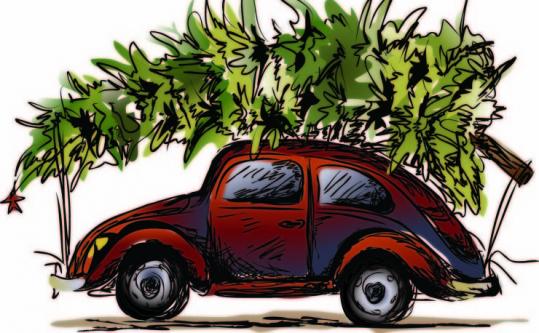
Learn How to Tie a Christmas Tree to a Car


Happy Holidays! As the weather shifts, relatives arrive in town, and the Christmas list continues to grow, the holidays spark a certain cheer in every one of us.  Whether you’re celebrating Hanukah, Christmas, Kwanza, or the neighborhood festivities, the holidays are a time of family, friends and….STRESS.  Lets be honest, the shopping season is booming, you’ve got TONS of gifts to pick up and you STILL haven’t had time to create that “pine smell” with a fresh Christmas tree in your living room.  Well, we’re here to help.  In today’s blog post, we’re going to show you HOW to tie a Christmas tree to your car.  

So, make sure you have heavy gloves, a warm jacket and plastic sheeting. First, put on your gear and shake your new tree.  This will loosen any foreign objects, as well as loose branches.  Place a sheet of plastic over the roof of your car to protect the paint and finish.  Now, lift the tree and place it on the roof.  Have a partner if your tree is larger than 6 feet.  Next, wind the rope or bungee cord all around  - over the tree, then under and back over the tree until it is secure.  Tie the rope or cord securely. Pull on the tree and make sure it’s tightly tied.  Ta da! An additional tip: bring your own rope or bungee cord when you buy your tree and always face the tree with the trunk end forward! (this will prevent wind breaking off branches while you’re driving.

Happy Holidays!!!!!!!

Wednesday, November 28, 2012

Driving in Snow and Ice


Let’s be real, the best advice for driving in bad winter weather is to not to drive at all. Whether it’s work, school or a meeting, we all have places to be.

If you must drive in the snow, please read this tips before going out to assist you with making it to your destination safely.

·      If you must drive in snowy conditions, make sure your car is prepared (Check ignition, brakes, wiring, hoses, fan belts, battery, antifreeze, etc).
·      Don't go out until the snow plows and sanding trucks have had a chance to make the roads safer.
·      Allow yourself extra time to reach your destination.

It's helpful to practice winter driving techniques in a snowy, open parking lot, so you're familiar with how your car handles.


Driving safely on icy roads:
·      Slowdown and leave yourself plenty of room to stop. Allow at least three times more space than usual between you and the car in front of you.
·      Brake gently to avoid skidding. If your wheels start to lock up, ease off the brake.
·      Keep your lights and windshield clean.
·      Drive with our lights on, even in the day, to increase your visibility to others.
·      Don't use cruise control or overdrive.
·      Be more so careful on bridges, overpasses and infrequently traveled roads. These tend to freeze first.
·      Don't pass snow plows and sanding trucks. Not only do the drivers have limited visibility, but they are making the road safer for you to drive on.
·      Don't assume your vehicle can handle all conditions. Even four-wheel and front-wheel drive vehicles can encounter trouble on winter roads.
·      It's helpful to practice winter driving techniques in a snowy, open parking lot, so you're familiar with how your car handles.


If you get stuck:
·      Do not spin your wheels. This will only dig you in deeper. In many cases, this will melt than refreeze the snow you’re on.
·      Turn your wheels from side to side a few times to push snow out of the way.
·      Use a light touch on the gas, to ease your car out. Don’t slam the gas.
·      Use a shovel to clear snow from the wheels and from underneath the car.
·      Pour sand, gravel or salt in the path of the wheels, to help get traction.


Thursday, November 15, 2012

Learning to Read a Car Tire


In our blog entries, we like to provide insight on options that can simplify your life when it comes to your vehicle.  In today’s instance, we’re going to provide you with tips on how to read a tire.  Knowing how to read your tire can provide detailed information like the type of vehicle, if they’re seasonal, the speed rating, temperature resistance, as well as the width and diameter of the tire. 

Read the manufacturer and the tire name.  These are easy! They are printed in large letters toward the outside of the tire.  With more than 100 tire manufacturer’s it might be hard to pinpoint the perfect one for your vehicle.  By contacting our service department, we can help you find a perfect fit.  The tire name might just be a combination of numbers and letters following the manufacturer name.

Width and aspect ratio.  This is a sequence of numbers near the center of the tire.  They would look something like www/aa/SCrr or www/aaCrr.  The first series of 3 numbers tells width in millimeters (from 155 to 315).  The 2 numbers after the slash show the aspect ratio of the tire. 

The prefix in front of the width and aspect ratio drtermine type.
LT – Light truck
P – Passenger
BP – Cosmetically Blemished Passenger
ST – Steel Radial

The load index is the tire size's relative load carrying capabilities. The higher the load index number, the larger load carrying capacity.

The Z,W, and Y ratings are for tires that have extremely high top-speed capabilities.

The cold inflation numbers are near the inner edge of the tires.  This tells you the pressure the tire should be at to optimize performance.

If you have any further questions, please contact us at the dealership for more info!